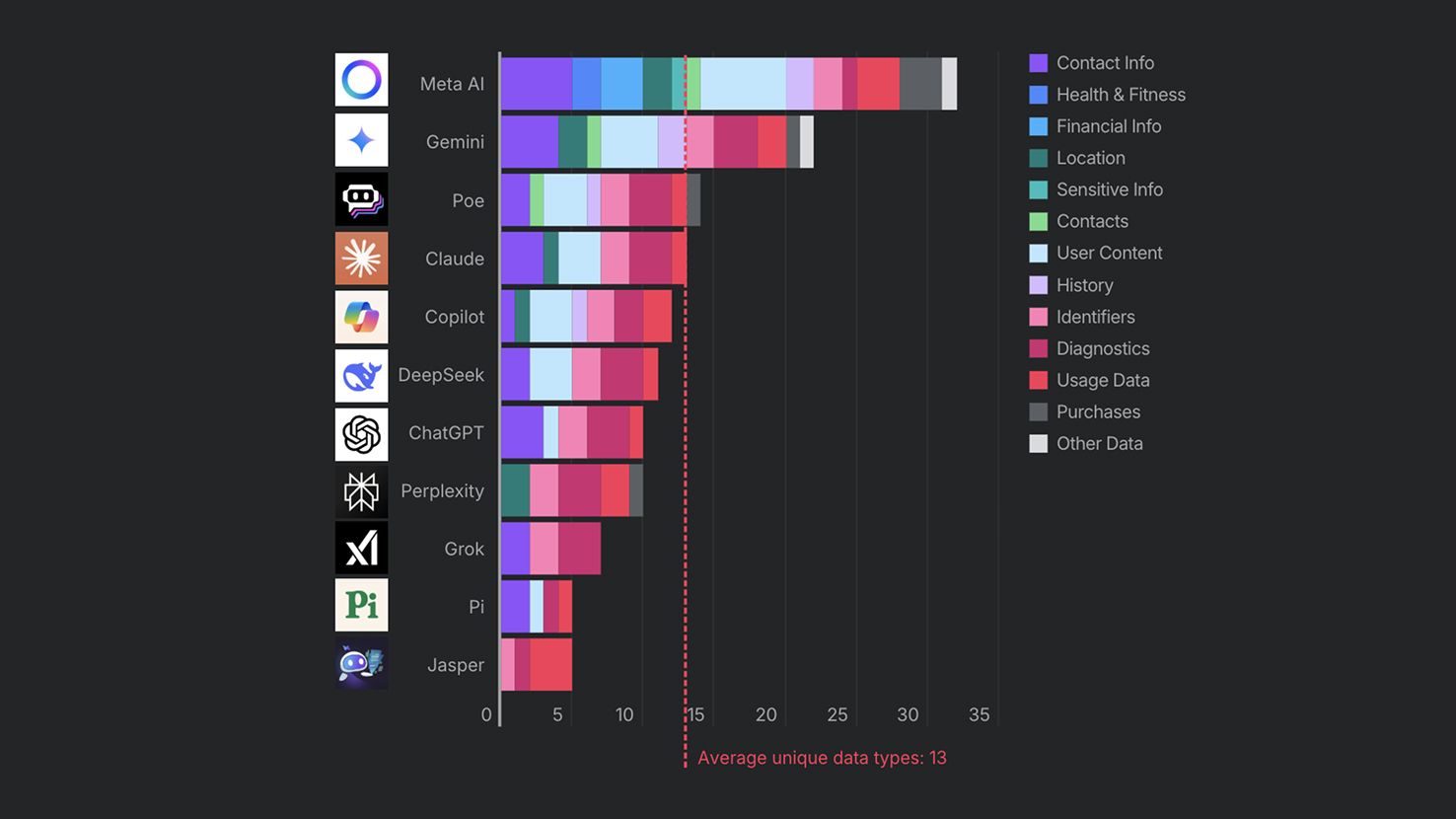
Using popular AI chatbots often comes with an invisible price — your personal data. A new Surfshark report analyzed the privacy disclosures and policies across 10 leading AI platforms, including ChatGPT, Claude AI, DeepSeek, Google Gemini, Grok, Jasper, Meta AI, Microsoft Copilot, Perplexity, Pi, and Poe); Surfshark assessed how much data these systems collect, how it’s linked to your identity, and whether it’s sold or used for third-party advertising.
Key takeaways:
- On average, each chatbot collects 13 out of 35 possible data types, including contact info, location, health details, financial info, search history, and more.
- 45% of the apps collect location data.
- 30% of them track your data across apps or sell it to data brokers.
Top Privacy Offenders
- #1: Meta AI
Collects 32 of 35 data types (over 90%), including financial, health, and sensitive personal data. Meta AI is the only chatbot gathering data across all categories, and it heavily uses that data for targeted advertising and broker sales.
- #2: Google Gemini
Collects 22 data types, including precise location, contact lists, search history, and browsing history. While Gemini is marketed as a smart, helpful assistant, it is deeply integrated into Google’s vast advertising ecosystem, one of the largest data monetization systems in the world.
- #3–5: Poe, Claude, Copilot
Poe collects 14 types, Claude 13, and Copilot 12. All three utilize device IDs to enable targeted advertising or data resale.
- #6: DeepSeek (China)
Collects 11 types of data, including chat history. DeepSeek raises serious concerns about censorship, surveillance, and data sharing with Chinese government-linked entities.
- #7–10: ChatGPT, Grok, Pi, Jasper
ChatGPT collects 10 types of data but does not use third-party ads or tracking, and offers deletion tools and opt-outs for training. Jasper, though last on the list, still collects device and ad data for targeting.
Bigger Picture: Why This Matters
The article highlights a systemic issue: the real cost of “free” AI or low-cost AI is your privacy. Most platforms rely on data exploitation to fuel their business models—tracking, profiling, and selling your information. While some offer settings to limit data use, the reality is that most users never adjust them, leaving their information vulnerable to surveillance, breaches, and exploitation.
Surfshark’s core advice? Be vigilant:
- Review privacy policies
- Adjust your settings
- Choose platforms designed for privacy-by-design.
How Rainfall Protects You
Rainfall’s AURA (your self-owned personal AI) stands out in sharp contrast to the practices outlined above. It is not just “privacy aware” — it is privacy sovereign. Here’s how Rainfall protects you at every level:
1. No Central Data Collection
Rainfall does not collect your personal data. Your AURA, which you generate, is built and operates locally on your device or within secure, decentralized environments. No central servers are ingesting your prompts, identity, or interactions.
2. Blind Compute & Multi-Party Privacy
Rainfall uses cutting-edge blind compute and multi-party computation (MPC), ensuring that even when outside coordination is required, no single party (not even Rainfall) can see your raw data or reconstruct it.
3. Zero Profiling or Behavioral Tracking
AURA does not track you, profile your behavior, or tailor advertisements to you. Your interactions are private, ephemeral, and non-transferable. Unlike Meta AI or Gemini, Rainfall has no ad-based business model or third-party sharing.
4. Self-Sovereign Identity (SSI) & Aura Vault
Your identity and personal information live inside your Aura Vault — a secure, encrypted, user-controlled vault. You hold the keys, and only you decide what (if anything) leaves it.
5. Differential Privacy for Collective Insights
When aggregated data is needed, Rainfall applies differential privacy methods, ensuring no individual can ever be identified. This enables learning at the group level while preserving individual anonymity.
6. User-Aligned Monetization
Rainfall’s economic model rewards you for your participation and data. There is no hidden data resale, no data broker pipeline, and no behind-the-scenes tracking. You remain the sovereign owner of your digital self and your personal AI.
Final Word
Where other AI platforms turn you into the product, Rainfall flips the script: you own your AURA, your data, and your intelligence.
In a world of exploitative AI, Rainfall offers a self-sovereign future where privacy is not just protected but guaranteed by design.